Guide · Updated
Hook vs headline: what's the difference?
The short answer
A headline is the title that gets someone to click or open. A hook is the first thing they read once they're in, and its job is to keep them reading. The headline makes a promise, and the hook starts to pay it off with a scene, a question or a surprise.
People mix these two up all the time, and I get why. On a tweet or a Substack Note there's no title, so one line does both jobs. But anything with a title, like a newsletter, a blog post or a video, has two jobs and two lines.
I think of it like a shop. The headline is the sign out front. The hook is what you see the second you walk in. A great sign with an empty shop loses people fast.
| Headline | Hook | |
|---|---|---|
| Where it shows | Inbox, feed, search results | The top of the newsletter itself |
| Its job | Get the click or the open | Get the read |
| The reader is | Still deciding | Already in, but can still leave |
| What works | A clear promise, a name, a number | A scene, a question, a surprising fact |
5 real headline and hook pairs
Each one is a real Substack newsletter. The headline is its title. The hook is how it opens, copied exactly.
1. Ted Gioia: the headline promises, the hook starts the story
HeadlineThe Ugly Truth About Spotify Is Finally Revealed
Hook“In early 2022, I started noticing something strange in Spotify’s jazz playlists.”
Ted Gioia on Substack newsletters · @tedgioia, The Honest Broker · . 10,276 likes, 620 comments.
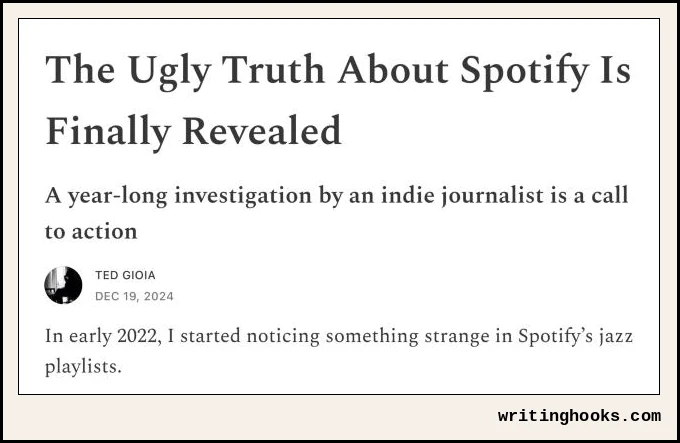
Newsletter by Ted Gioia on Substack, December 19, 2024. Why it works: The headline promises a secret you're about to learn. The hook doesn't repeat that promise. It drops you into the moment he first noticed something was off, so you follow along like a detective.
2. Adam Mastroianni: the headline names it, the hook says it plainly
HeadlineThe Decline of Deviance
Hook“People are less weird than they used to be.”
Adam Mastroianni on Substack newsletters · @experimentalhistory, Experimental History · . 14,311 likes, 733 comments.
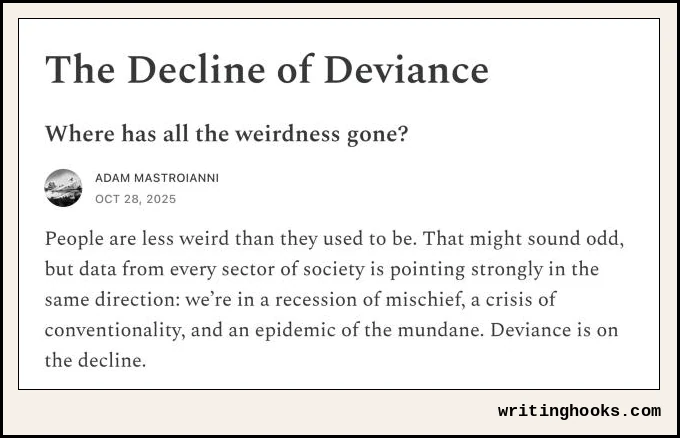
Newsletter by Adam Mastroianni on Substack, October 28, 2025. Why it works: Say the headline out loud: "Decline" and "Deviance" both start with the same "D" sound. That's called alliteration, and it makes a title roll off your tongue and stick in your head. "Deviance" is also a big, formal word, so the title sounds like a big idea. Then the hook says the same thing in eight plain words, and it's a surprise. Is that true? You read on to find out.
3. Adam Mastroianni: the headline pokes you, the hook tells a tiny story
HeadlineFace it: you're a crazy person
Hook“I meet a lot of people who don’t like their jobs, and when I ask them what they’d rather do instead, about 75% say something like, “Oh, I dunno, I’d really love to run a little coffee shop.””
Adam Mastroianni on Substack newsletters · @experimentalhistory, Experimental History · . 12,616 likes, 458 comments.
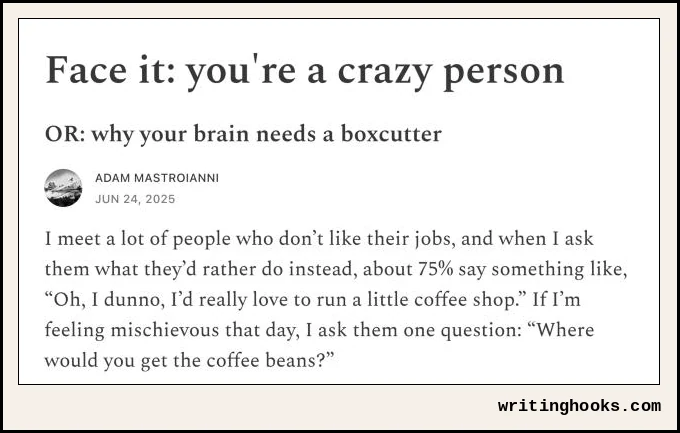
Newsletter by Adam Mastroianni on Substack, June 24, 2025. Why it works: The headline pokes you, so you click to see if it's about you. Then the hook calms down and tells a small story you know. Most of us have heard the coffee shop dream, so you're nodding along before you know it.
4. Ted Gioia: a vague headline, a hook that raises the stakes
HeadlineThe Ten Warning Signs
Hook“Would you believe me if I told you that the biggest news story of our century is happening right now—but is never mentioned in the press?”
Ted Gioia on Substack newsletters · @tedgioia, The Honest Broker · . 3,200 likes, 517 comments.
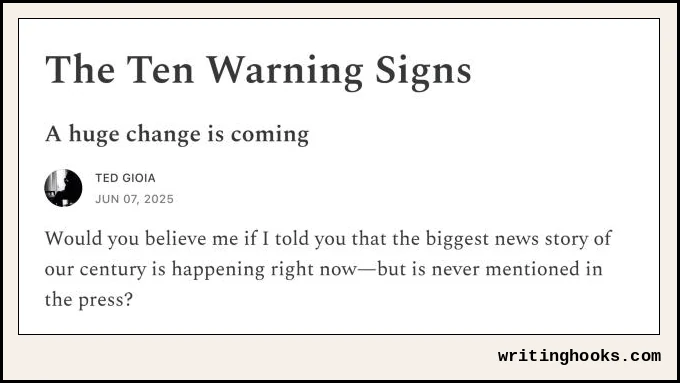
Newsletter by Ted Gioia on Substack, June 7, 2025. Why it works: On its own, "The Ten Warning Signs" doesn't say much. Warning signs of what? That gap gets the click. Then the hook asks a question with huge stakes, which is a curiosity gap in one sentence.
5. Henrik Karlsson: an odd headline, a hook with a name and a date
HeadlineHow to walk through walls
Hook“In March 1991, Robert Rodriguez, then 22 years old, decided to write and shoot three feature-length home movies to gain experience making full-length films, in case he ever received an offer to direct a real one.”
Henrik Karlsson on Substack newsletters · @henrikkarlsson, Escaping Flatland · . 3,163 likes, 79 comments.
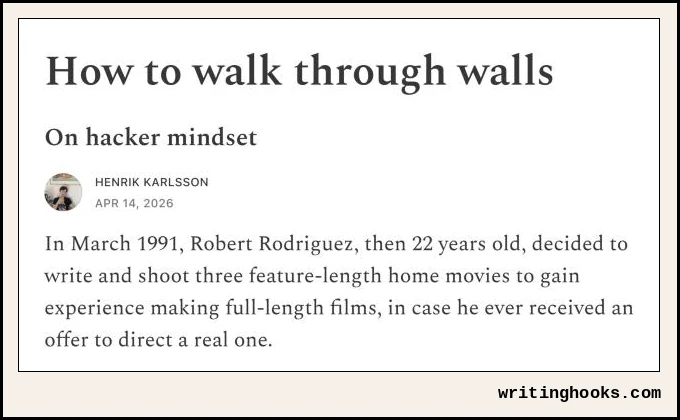
Newsletter by Henrik Karlsson on Substack, April 14, 2026. Why it works: You can't walk through walls, so the headline makes you curious. The hook answers with a real person, a real month and a real age. Small true details make a story feel real, and you want to know how it ends.
10 headline and hook pairs that you can fill in
Swap the brackets for your own words.
1.Headline“The [topic] mistake I made for [number] years.”
Hook“Every [day of the week], I did the same thing, and it was wrong.”
The headline promises a confession, and the hook starts the story.
2.Headline“Why [common advice] doesn't work.”
Hook“I followed [common advice] for a whole year. Here's what happened.”
A contrarian headline needs proof fast.
3.Headline“[Number] things I wish I knew before [milestone].”
Hook“The first one took me [time] to learn.”
The number sets the size, and the hook hands you item one.
4.Headline“The [adjective] truth about [thing].”
Hook“I wasn't supposed to tell you this, but [secret].”
A curiosity gap you close right away.
5.Headline“How I [result] without [the usual cost].”
Hook“[Number] months ago, I had [bad starting point].”
Show the before and after.
6.Headline“Stop [doing thing].”
Hook“You've heard it a hundred times: [advice]. It's wrong, and here's why.”
A short truth bomb, then the reason.
7.Headline“[Topic], explained in 5 minutes.”
Hook“If you only remember one thing about [topic], make it this: [point].”
A how-to that pays off in line one.
8.Headline“What [person or brand] gets right about [topic].”
Hook“Last week, [person] did something most people missed.”
A name in the headline, a scene in the hook.
9.Headline“Is [thing] dead?”
Hook“My [result] dropped by half in one week. Then I changed one thing.”
The question gets the click, and the drop makes you stay.
10.Headline“Everyone is wrong about [topic].”
Hook“Here's a question I ask everyone who [does thing]: [question]?”
A question in the hook makes the reader answer it in their head.
How to write a headline and a hook that work together
- Write the hook first. It's the start of the real piece. Get it right, then write a headline that sells it.
- Make the headline a promise. Say what the reader gets, or name something they're curious about. Keep it short enough to read at a glance.
- Don't repeat the headline in the hook. They just read it. Move forward with a scene, a question or a surprising fact.
- Pay off the promise fast. If the headline says "the truth about Spotify," the truth has to show up soon, or people feel tricked and leave.
- Read them together, out loud. They should sound like one idea. If your hook could sit under any headline, make it more specific.
Want more to borrow? I keep over 150 hooks in the hook library, sorted by style. For emails, there's a page of newsletter subject lines. And for posts with no headline at all, see my Substack Notes examples, where the hook does both jobs.
FAQ
- What's the difference between a hook and a headline?
- The headline gets the click. The hook gets the read. The headline sits outside your piece, in the inbox or the feed. The hook is the first thing inside it.
- Can a headline be a hook?
- Yes. A tweet, a Substack Note or a LinkedIn post has no title, so the hook does both jobs. In an email, the subject line is the headline and the way the email opens is the hook.
- What is a hook in news?
- News writers call it the lede. It's the opening sentence that tells you the most important or most interesting part of the story, so you want to read the rest.
- What is an example of a hook?
- "People are less weird than they used to be." That's Adam Mastroianni's opening for The Decline of Deviance. It's short, it's surprising, and it makes you want proof.
- How long should a headline be?
- Short enough to read at a glance. Put the main idea in the first few words, because feeds and search results cut long titles off.